Category: Legends

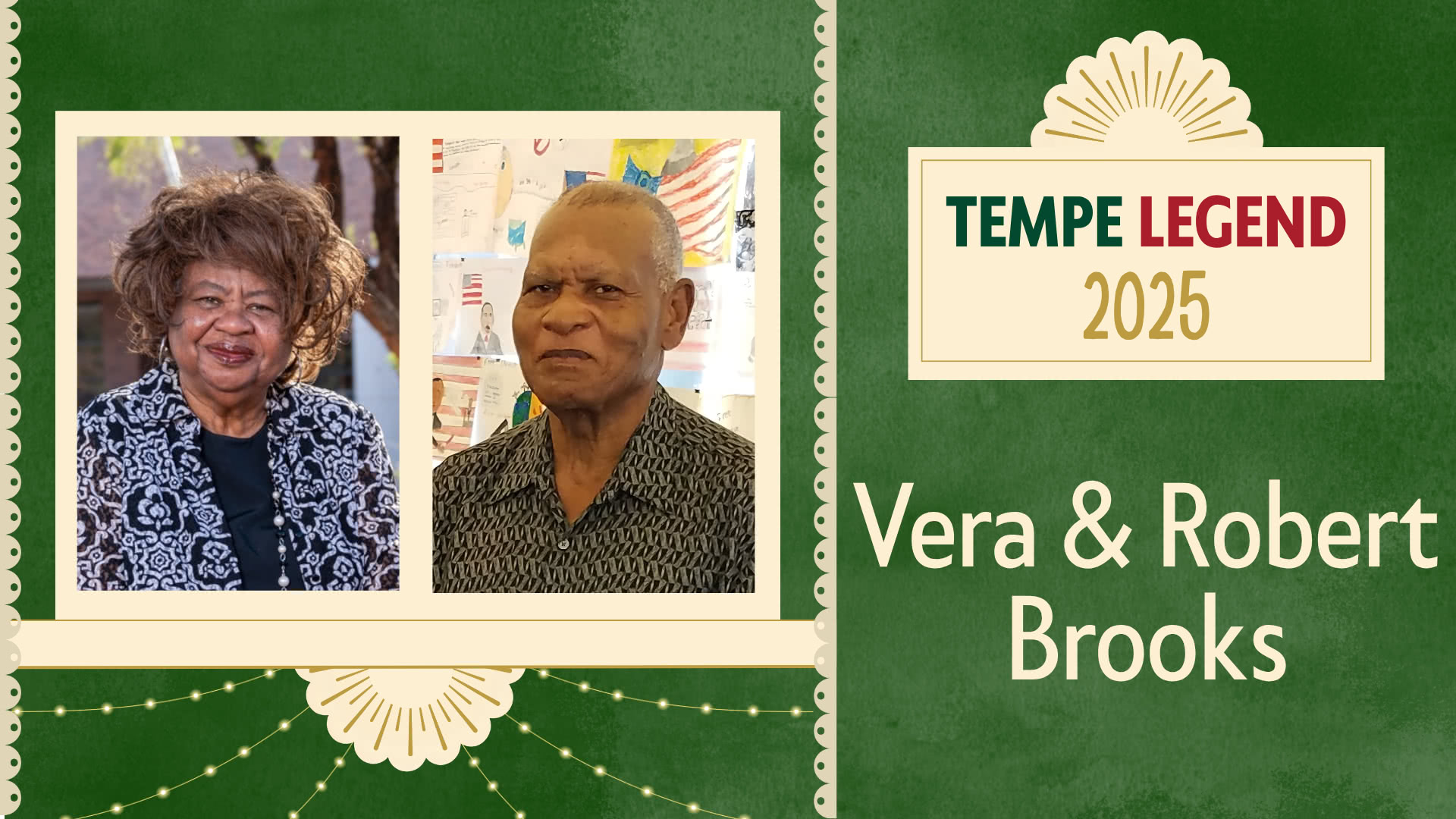
  • 2025 Living Legends – Vera and Robert Brooks

    2025 Living Legends – Vera and Robert Brooks

    Vera Brooks is known for her caring heart and helping hands, in addition to creating beautiful environments with her unique style of decorating.

    Vera’s compassion shines through her every endeavor – as an active member of the African American Advisory Committee of the Tempe History Museum, as a volunteer in Tempe, and as a co-founder and leader of a Girl Scout troupe in Tempe. She has volunteered at Wood Elementary School, lending her time and skills to help facilitate book sales and other school activities, as well as teacher appreciation events. She’s served the First Baptist Church of Tempe through its Vacation Bible School, Girls Brigade, and as an Awana leader.

    Vera is one of the co-founders of All God’s Children Collector’s Club which was established in Tempe over 30 years ago, and provides outreach to the community and other charitable organizations. Vera has received several awards from the City of Tempe including the Martin Luther King, Jr. Diversity Award and the Police Department’s Outstanding Service Award. Vera has enjoyed living in Tempe and volunteering in the community. Both she and her family have deep roots in the City of Tempe.

    Robert Brooks has resided in Tempe for over 55 years. He is a retiree from the City of Scottsdale with over 35 years of experience working in the public sector. He is known for his passion for supporting and mentoring the next generation.

    Robert has demonstrated his love and commitment to serving others by volunteering as a coach for the City of Tempe summer girls’ softball league for over six years. He served at First Baptist Church of Tempe as an Awana Leader and coach for over 10 years as well as serving as a Deacon.

    Robert is a member of the African American Advisory Committee of the Tempe History Museum which he helped found with previous Tempe Legend, Ed Smith. He also serves as current president of the All God’s Children Collector’s Club where he is the sponsor of the Salute to Service Event honoring our military veterans. Robert has received several awards from the City of Tempe including the Police Department’s Outstanding Service Award. He enjoys living in Tempe and contributing to the success of others.

  • 2025 Historic Legend – Michelle Brooks-Totress

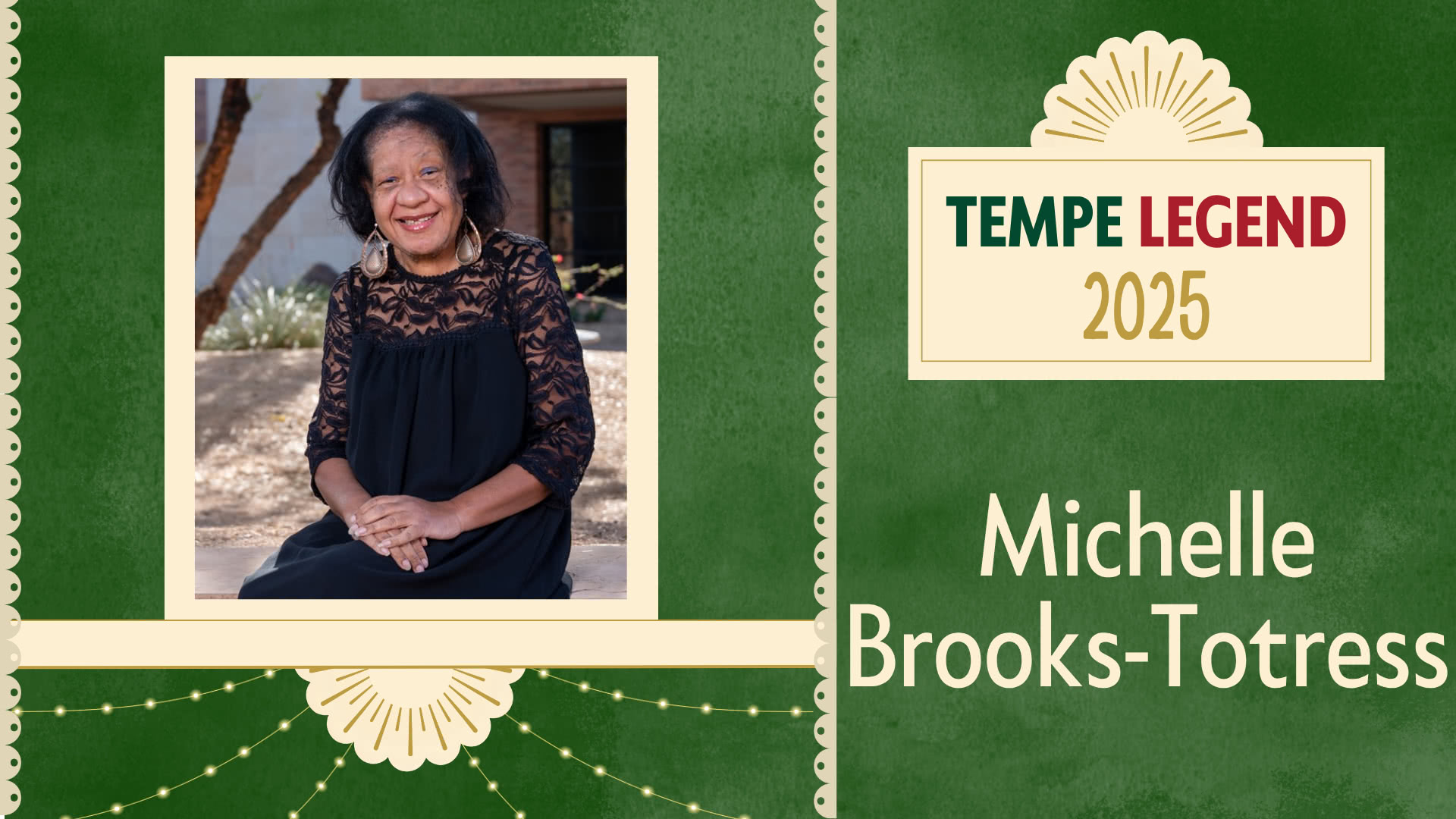
    2025 Historic Legend – Michelle Brooks-Totress

    Michelle Brooks-Totress’s (1961-2022) long-time humanitarianism and advocacy for civil rights, social justice and volunteerism in Tempe is admired and known throughout the City of Tempe’s administration. In addition to working 30 years as a librarian in Scottsdale, Michelle devoted much of her life to volunteering for numerous organizations to help establish events celebrating Black history and life. She was among those in 2008 who founded the African American Advisory Committee of the Tempe History Museum and served on its board for well over a decade, including as its chair. Michelle helped to establish the Black History Month Faith in Action Prayer Breakfast – an inter-faith event with representatives from the Christian, Jewish and Muslim faiths – and the annual Juneteenth Celebration at Tempe History Museum.

    Michelle also served as co-chair of the Sustainability Pillar for the Arizona Commission of African-American Affairs, and was a board member of the Arizona Career Development Center.

    On March 2, 2023, in recognition of her contributions to the Tempe Community, Tempe City Council voted to approve a new name for a recently renovated park originally located in the Hallcraft Home Subdivision: Michelle Brooks-Totress Park.

  • 2024 Historic Legend – Ladimir Kwiatkowski (Ladmo)

    2024 Historic Legend – Ladimir Kwiatkowski (Ladmo)

    Ladimir Kwiatkowski –( July 13, 1928-March 2, 1994). Yes, you know him: the thin, tall, clumsy kid with a top hat, rubber-faced expressions, and who wore long funny ties that came down to his knees. His best friends were Wallace and Gerald; he’s better known as Ladmo, the Arizona television personality and Emmy award-winning comedian who co-hosted “The Wallace and Ladmo Show”, a daily children’s variety show broadcast on KPHO: Channel 5, in Phoenix from April 1, 1954 to December 29, 1989–a period of 35 years!

    The program featured clowns, cartoons, dumb jokes and short comedy skits. The guests who appeared on the show were local and state politicians, popular entertainers, city council town representatives, police officers, the movers and the shakers of Maricopa County—all ready to deliver public service announcements or banter with Wallace and Ladmo, only to have a pie thrown in their faces or read the wrong cue cards—no one kept a straight face on camera when Ladmo, Gerald or Wallace ad-libbed funny stories or told dumb jokes. And Ladmo and Wallace gave away a prized brown paper sack to kids and called it “the Ladmo Bag: filled with candy, cans of soda pop, potato chips and prizes. –Today’s generations of fans confess: “I never got a Ladmo Bag when I was a kid.”—a metaphor for “I had a deprived childhood!” 

    As a young boy in his Cleveland neighborhood, Ladimir was known by his hometown boy-pals as “Laddie”, or “Lad” or “Slats”, because he was skinny. He loved baseball and wanted to be a major league player when he grew up. He often wore his public school’s baseball uniform to Sunday Mass, to waste no time to run out of the church when Mass ended to join his buddies at the baseball field ready to pitch or catch or hit baseballs with the best of them. Lad was a stand-out and gifted baseball player while attending Adams High School, a Class of 1947 graduate.

    He left Ohio to attend Arizona State College in Tempe as a Freshman in 1949 and wanted to be a sports broadcaster. Lad played on the ASC varsity baseball team from 1950 to 1954. In 1951, he led ASC in hitting, with a .358 average, including a single, two doubles, and a triple, in a game against the University of Arizona Wildcats. In 1952, Lad became Captain of the baseball team. It was said that he brought some respect to the ASC baseball program after being neglected by college sports personnel who paid more attention to other sports programs that brought in money. While at ASC, Lad majored in Journalism and wrote the sports column for the college newspaper, “State Press “—known as “Kwiat’s Kwikies”—a word play on his surname, Kwiatkowski.  Lad caught the attention of Ohio’s baseball scouts, who offered him an opportunity to play baseball for the Cleveland Indians farm team, playing in the minor leagues and maybe move on up to play professional ball one day. The thought appealed to him, but the “wait-to-play-ball-one-day” rhetoric didn’t. What appealed to Lad more was this new thing going on in the Salt River Valley and in Arizona homes. It was called “television.”– KPHO-TV, Channel 5.—the perfect place where his journalism skills of writing, reporting and telling new stories would be more important.

    The morning after Lad graduated from ASC, he went to the KPHO-TV office at 9:00 am, and at 11:00 am, he received a call: when can you begin? The next day, Lad began a new job at KPHO-TV, doing whatever he was assigned to do: sweep the floors; fold office chairs; run the tv cameras during live broadcasts, and eventually produce and direct television shows. Among the more popular kids’ shows in 1956 at KPHO-TV-5 was called “It’s Wallace”, with Bill Thompson being the funny guy, “Wallace”, with the jokes and routines. Lad became fascinated with the program because of its wide appeal to children, young boys and girls. It made him laugh a lot too. Bill Thompson noticed Lad. One day, Bill convinced Lad to appear with “Wallace” and perform a funny skit: it worked! The character forever known as “Ladmo” was born. Joining them in 1959 was the hilarious character known as the spoiled rich kid, “Gerald”, portrayed by the gifted comedian, Pat McMahon.  They were the complete opposites, which made for some great character sketches and skits: Ladmo loved sports. Gerald didn’t. Ladmo made “C’s” in school. Gerald made “A’s”. Ladmo loved the kids. Gerald thought they were “public school brats”. Ladmo liked rock-n-roll. Gerald loved classical music. Gerald’s goal was to make Ladmo’s life miserable. And it was “Wallace and Ladmo” and Gerald– making comedy history on KPHO-TV-5 for 35 years: appearing as buffoons, funny guys, pranksters, clowns, jokesters, at public parks, popular theatres, at Legend City, schools, football stadiums, —all making children laugh. On December 29, 1989, the last “Wallace and Ladmo Show” was aired on Chanel 5, KPHO-TV. The longest-running kids’ television show in broadcast history that featured the same characters/actors: Wallace: Bill Thompson.  Ladmo: Ladimir Kwiatkowski. And Gerald: Pat McMahon. Ladmo’s interest in baseball kept him busy after his retirement. When he learned that there was no baseball program for children in Tempe, he initiated in the summer of 1955 a “pee-wee league” for children aged 5 and 6 years of age; and a “rookie league” for children aged 7 and 9 years of age. The Summer games were played at Tempe High School on Monday to Friday, from 8 am to 10 am.  By 1961, Ladmo began coaching night leagues for children aged 10 to 18 years of age. The Tempe Junior Chamber of Commerce named Ladmo “Man of the Year”. In 1963, the Arizona Junior Chamber of Commerce added his name to their “Outstanding Young Men” award. —-Ladmo: a friend to the child in each of us.   Ladmo: a Tempe Legend.     
  • 2024 Living Legend – Dr. Frederick H. Warren

    The essence of a well-seasoned and highly respected Educator and a life-long practitioner of equity and inclusiveness in all aspects of his work and life. His father’s family came from Texas to the Salt River Valley in 1925. His mother’s family came from North Carolina in 1907. Dr. Warren’s parents attended the Phoenix Union Colored High School, known today as the George Washington Carver High School, which is listed on the National Register of Historic Places. They are his examples of struggle, sacrifice, and courage, and he understood their determination to rise above school segregation and the racism that challenged them.

    Dr. Warren’s pride as a member of the Class of 1953, George Washington Carver High School, with its stellar Principal, faculty and staff, continues to serve as his inspiration to overcome hardships that are often linked to the matter of civil rights. His high school experience has served him well.  

    Dr. Frederick H. Warren served as an elementary school teacher for the 5th grade at Longfellow School. He was the Principal of a school for special needs students and the first African American Associate Principal for Phoenix Union High School. He became School Superintendent for Roosevelt School District, with a student population of 12,500.  Dr. Warren attended Pepperdine University Law School in Los Angeles, and earned a Master of Law, Juris Doctor. His top-rated education and legal training enabled him to become Grants Compliance Administrator and Housing Rehabilitation Program Administrator for the City of Phoenix. And later, a Maricopa County Justice Courts Dispute Resolution Mediator for the Phoenix Regional Office of the U.S. Equal Employment Opportunity Commission.   Dr. Warren is a true and notable Tempe legend in his own time.

  • 2024 Historic Legend – Ray Martinez

    2024 Historic Legend – Ray Martinez

    Ray Martinez (1918-2002) —Born in Tempe, Arizona, in 1918 and passed away on December 5, 2002, at the age of eighty-five. He served in the U.S. Navy during WWII, trained as a radio man and served on the USS Macaser Straits until 1944 when he was injured in an enemy attack and sent to a hospital in San Diego until he recovered. Ray’s tour of service included duties for supporting American forces for the Pacific Island invasions, including Iwo Jima.

    After service, Ray returned home with a strong sense of duty and unity to address the long-standing and persistent practices of racism and discrimination the Tempe and Phoenix communities of Mexican American veterans and their families experienced.

    The formation of the American Legion Tony F. Soza-Ray Martinez Thunderbird Post 41 in 1945 provides an example of how veterans organized for equality. Their first challenge came in the early Spring of 1946: Tempe’s veterans approached Ray Martinez and asked for Post 41’s assistance in the elimination of the 1923 “No Mexicans Allowed” policy at Tempe’s public Olympic-sized swimming pool and recreation center, known as Tempe Beach. It was built on land donated to Tempe by Charles Trumbull Hayden. This 23-year-old policy was approved and sanctioned by the City of Tempe and enforced by the Tempe Chamber of Commerce. The veterans arranged to begin a series of discussions with members of the Tempe Chamber of Commerce and the City of Tempe, and they met often. Veterans spoke of their honorable military service and American patriotism during wartime. They explained why the segregation of Americans like them at Tempe Beach was un-American. Veterans deserved better, they said.  They argued that they proved their American loyalties and bravery. Segregation was wrong, they reasoned. Convincing arguments, indeed.   Finally, on May 21, 1946, the Tempe Chamber of Commerce and the City of Tempe agreed to end their “No Mexicans Allowed” policy at Tempe Beach.

    Ray Martinez served as Post 41’s Commander from 1945 to 1948. In 1950, he became the first Mexican American Vice Commander, American Legion, Department of Arizona. The following year, he was elected as Commander, the first Mexican American nationally to serve in the State Commander status. Ray Martinez is the first Mexican American to hold a State Supervisory Office as Commander of Civil Defense. He became the National Chairman for the American Legion’s Department for Children and Families. In addition, Martinez served as Children and Youth Commission Chairman for 27 years and was elected as Chairman of the Legion’s Western States Commission. Commander Martinez was instrumental in establishing the Arizona State Veterans’ Home.  Ray Martinez was inducted into the Arizona Veterans Hall of Fame in 2001, the first year of its establishment.