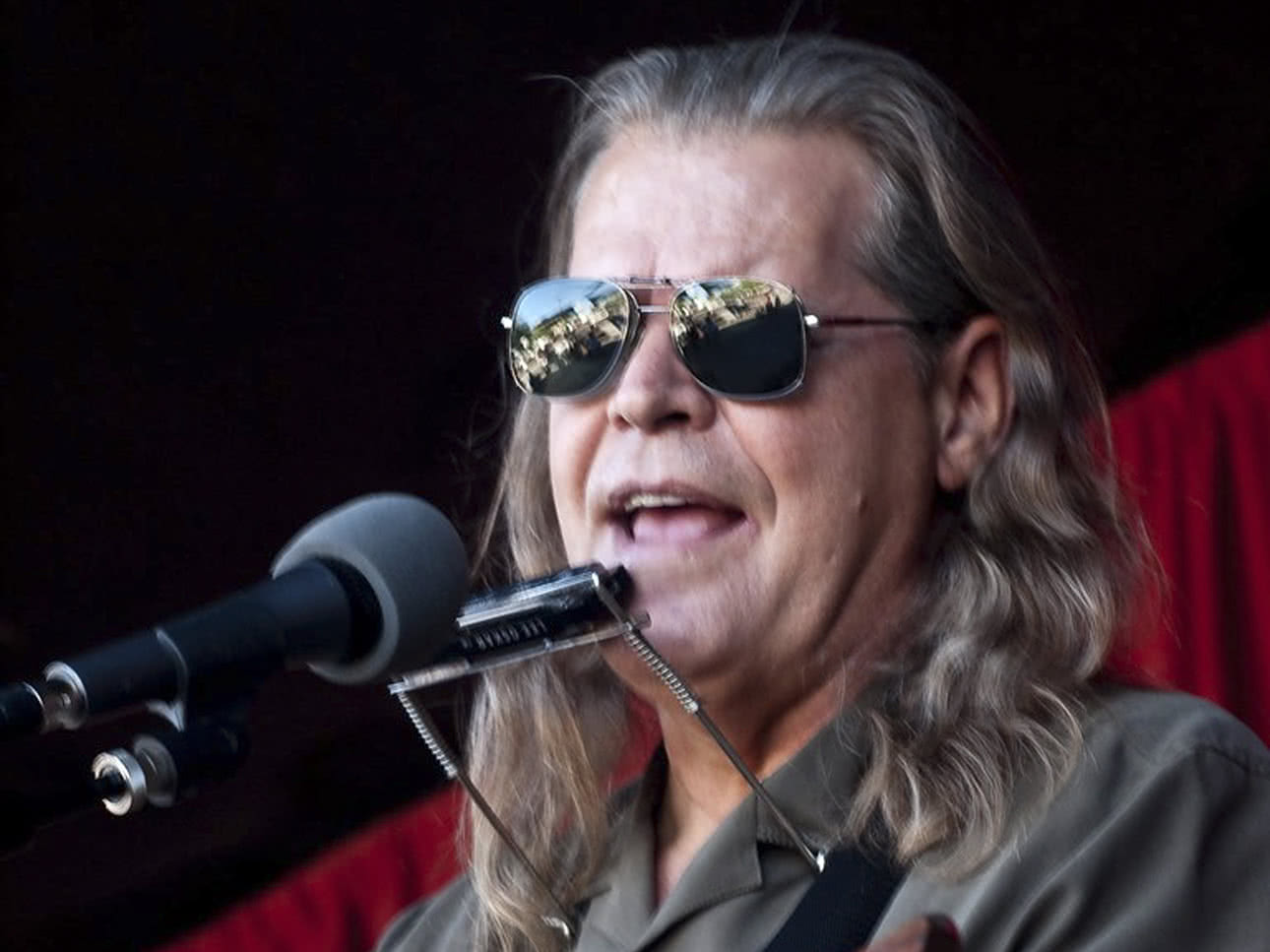
If there ever were someone to epitomize the phrase, “your favorite musician’s favorite musician,” Hans Olson would be that someone. Despite a lack of mainstream success, the man is one of the premier musicians of Tempe and Arizona. Olson represents a musical style that, while not necessarily Arizona in origin, represents the state and its personality almost perfectly. His blend of blues, rock, folk, and country styles embodies the unique styles endemic to Arizona and its people. His music contains a grit and occasional dark edge, calling back to the state’s glorified old west roots. That is no accident. As Hans described in various interviews, being a musician in Tempe is no easy task.
In an interview conducted by the Tempe History Museum, Hans told how many venues in Tempe do not even have staff to help the artist set up the sound equipment. Thankfully, this was a skill that Hans himself picked up. He cites his prowess with the setup as an essential factor in allowing him to make a living as an artist in a tough town. Hardship was something that Hans learned to deal with at a young age.
At the age of five, Hans unfortunately lost his eye in an accident involving a stray arrow. That young age likewise saw the loss of his father. No doubt it was a trying time for anyone, but at this crucial juncture in his early life, Hans discovered his passion: entertainment. The young boy was enamored with the image of Gene Kelly dancing, and further inspired a few years later by the singing of legendary country artist Johnny Cash, Olson decided to play music and perform for a living. The young man did not have to wait long. A few years after his fateful encounter with the Man in Black’s music, Hans became the singer in a band native to his hometown of San Bernadino, California. Amusingly, Hans got the gig after his sister suffered from such severe stage fright that her audition could not be completed, and the band liked his voice. At fifteen, Hans began to sing and perform in various bars and clubs around the area; thankfully, he looked old enough, even in his adolescence, that no one bothered to check his age. Shortly after that, he also learned how to play the harmonica alongside the guitar, which would become the style of music and play the most esteemed, often dubbed the “harp-in-a-rack.” Hans Olson is frequently cited as the best player of the style.
However, as is commonplace, Hans moved. During his senior year of high school, Hans moved from the LA area to a place he initially viewed as boring- Tempe. Despite his reservations about the smaller town, which he thought would be boring and stuffy compared to the fast-paced and ever-changing California, Hans quickly found the opposite true. Hans talks of the exciting and fun-filled place that was Tempe in the early 1970s. Despite not having a reputation for it, Hans discovered that Arizona possessed a vibrant and exciting music scene, the legacy of which he would devote his current life to preserving. Hans helped to put on concerts in the early 70s at Papago Park and invited many bands. In the 70s, Hans began to achieve mainstream success, even playing to a crowd of over 20,000 people. He has played and performed with several high-profile bands and artists, including the Allman Brothers Band, ZZ Top, and John Fogerty.
Most notable for Olson is that he played with one of the most renowned and admired blues musicians of all time, Muddy Waters. Waters inspired Olson and just about every other blues player, but aside from the thrill of playing with one of the legends, there was no doubt that the compliment that Olson received from Muddy Waters made the experience unforgettable. Waters complimented Olson on his uniqueness as a performer and as an artist. Many play the songs of Waters precisely as he played them, but Waters himself was impressed at how Hans Olson took the famed works of Muddy Waters, made them his own, and played the famous songs in the style that was uniquely Hans Olson. Perhaps no more excellent thing can be said of a musician than that. Olson has also found mainstream success.
Many commercials and television programs have utilized songs written by him, and many likely have found themselves listening to one of his pieces unaware. Han’s uniqueness as a musician has firmly allowed him to root himself in underground and mainstream circles. On the same night, one could walk into a bar and hear him play while at the same time, a family could be humming a jingle he crafted on TV. Many artists cannot distinguish between artistic and creative freedom, commercial success, and financial stability. Hans Olson might thread that needle better than any other before him or since. This trait demonstrates the toughness and ingenuity that Olson frequently cites as a requirement for any musician looking to make it to Arizona, as it is a state that demands much of the artists who make this state home.
Hans Olson’s acclaim comes from his musical talent, but the man is multifaceted. Olson’s importance to the state of Arizona delves into the realm of politics, as he helped to found the Green Party of the state of Arizona. He credits much of his success in that endeavor to the simple fact that he started something. Hans Olson is also a starter of other organizations, one of the most famous being a leading force behind the Arizona Blues Hall of Fame, The Arizona Music Heritage Foundation, and the Arizona Music and Entertainment Hall of Fame. All of which showcase one of the most admirable traits of the man. His desire to see the past preserved, honored, and shared for posterity.
Arizona is no longer a place that the average man thinks of when discussing musical scenes. Hans partly attributes this to Arizona’s unique music scene, which is less supportive of the artists hailing from it than other areas. Despite that, Olson still contends that Arizona and the Valley have a unique musical scene and history that should be known, especially among Arizonans unaware of their state’s contributions to music. Despite occasional rough goings during the setup of these organizations, what cannot be understated is the dedication Olson showed in helping people understand that Arizona is a state with a vibrant musical history that should be respected, preserved, and celebrated.
Hans Olson has lived a varied life, but a few things have been constant. He is a musician through and through. Never deviating too far from his original dream of entertaining and playing the music that he loved. Hans also acted, not content to opine on what should happen; he often took steps to make sure it happened or, at the very least, got the ball rolling. Whether this meant helping to found a political party, starting historic preservation organizations, or halls of fame meant to honor great musicians from the past and preserve their legacy, Hans Olson helped create things. Finally, Hans Olson has lived out the toughness and resilience that he has stated is a must for artists in the Grand Canyon State. Hans Olson has lived a life that epitomizes Tempe. It has been unique, varied, and in many cases complex, yet characterized by a toughness that has been the throughline of it all. Despite slowing down, he shows no signs of stopping anytime soon, and if one thing is clear based on his past, he will continue to play a part in things around Tempe for years to come.